
Posted on Sep 2, 2026
Background
.png?width=550&height=423&name=Group_1321315967%20(1).png)
Lactate is one of the major metabolic byproducts in CHO cell culture. Previous studies have reported that lactate concentrations above 1.5–2 g/L can begin to inhibit cell growth, while concentrations exceeding 3.5–4 g/L can significantly reduce protein expression and affect the glycosylation profile of host cells². However, lactate is not simply a metabolic waste. While excessive lactate accumulation can negatively affect cell culture performance, lactate can also be reutilized as a carbon source during the middle and late stages of culture. In fed-batch and perfusion processes, the lactate profile—from production to plateau and subsequent consumption—is often considered a key indicator of process health.
Therefore, maintaining lactate metabolism within an appropriate range during CHO cell culture is critical for sustaining cell growth and improving recombinant protein expression.
Lactate production is regulated by multiple factors, primarily the cell line, cell culture media formulation, and the cell culture process.
The genetic background and metabolic characteristics of the cell line determine its capacity for lactate production and utilization. The cell culture media formulation influences cellular metabolic flux by regulating the composition and concentration of carbon sources, amino acids, metal ions, and other nutrients, among which copper ion concentration plays a particularly important role in regulating lactate metabolism. In addition, process parameters such as inoculation density, feeding strategy, dissolved oxygen (DO), pH, and culture temperature further regulate cellular metabolic states and lactate accumulation.
Through the coordinated optimization of cell line selection, media formulation, and cell culture processes, lactate production and reutilization can be effectively controlled. Maintaining lactate metabolism within an appropriate range can help improve the culture environment, support cell growth, extend the culture duration, and ultimately enhance recombinant protein expression.
Profiling Lactate Metabolism and Potential Solutions
As shown in Figure 2, lactate concentrations increased during the early stage of culture under all three conditions. Subsequently, lactate was gradually reutilized by cells in the shake flask 1 (SF1) and shake flask (SF3) groups, resulting in a significant decrease in lactate concentration. In the SF3 group, lactate levels remained close to zero, whereas lactate began to accumulate again during the late stage of culture in the SF1 group. In contrast, lactate continuously accumulated in the SF2 group and remained at relatively high levels during the middle and late stages of culture.
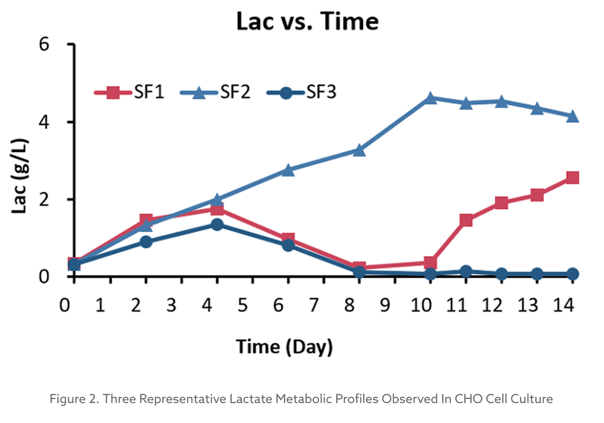
These three lactate profiles represent three typical metabolic patterns observed during CHO cell culture:
- SF1: Late-stage lactate rebound, characterized by lactate reutilization followed by renewed accumulation during the late stage of culture.
- SF2: Continuous lactate accumulation, characterized by persistent lactate production throughout the culture process.
- SF3: Normal lactate metabolism, characterized by lactate accumulation during the early stage of culture, followed by cellular reutilization and maintenance at a relatively low level.
Different lactate metabolic patterns require corresponding process optimization strategies.
Problem 1: What should be done when lactate continues to increase?
For cultures exhibiting continuous lactate accumulation, the underlying causes are generally associated with the metabolic characteristics of the cell line, media composition, feeding strategy, and other process-related factors. Potential approaches include screening or switching to low-lactate-producing cell lines, optimizing the media formulation, and adjusting the feeding strategy to reduce lactate production and prevent excessive accumulation.
Problem 2: What should be done when lactate rebounds during the late stage of culture?
Late-stage lactate rebound is often associated with the feeding strategy and oxygen transfer conditions during the culture process. Process optimization strategies such as optimizing the feeding frequency, increasing agitation speed or oxygen transfer efficiency, and appropriately reducing the initial culture volume can help improve cellular metabolic status and prevent renewed lactate accumulation during the late stage of culture.
OPM Case Studies on Lactate Regulation
1. Feeding Strategy Optimization
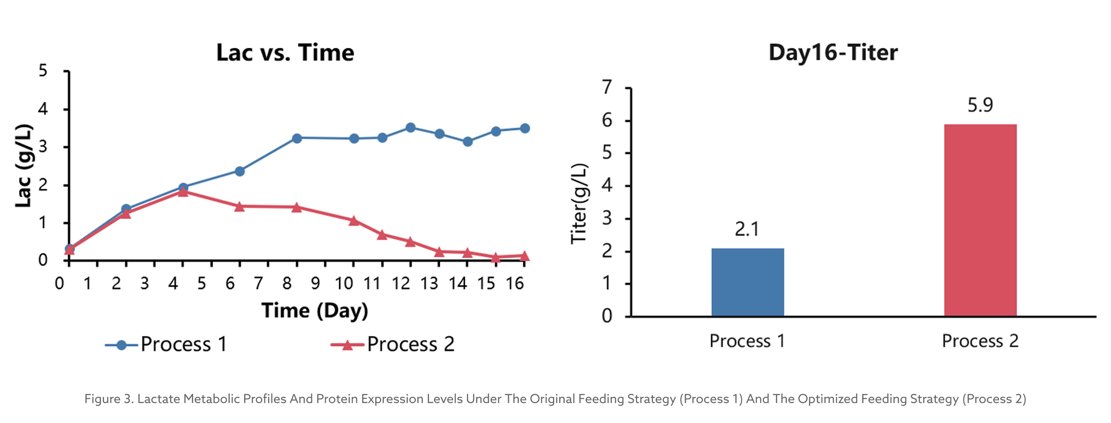
OPM optimized the feeding strategy by changing from feeding every other day to daily feeding, significantly reducing lactate levels throughout the culture process. Protein expression increased by 180% compared with the every-other-day feeding strategy.
2. Media Optimization
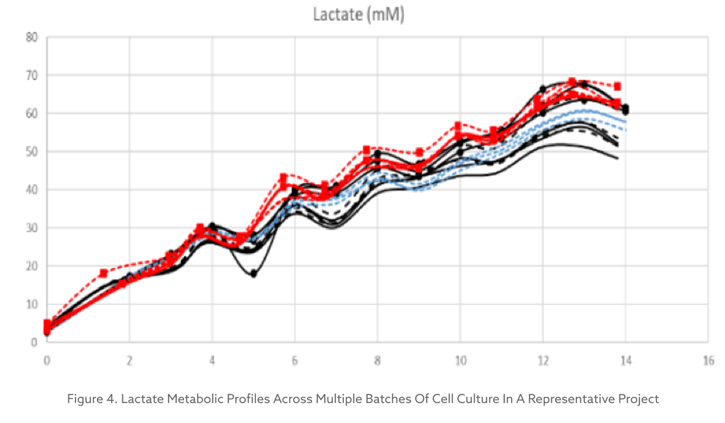
In a representative project, lactate continuously accumulated during cell culture under the original process conditions, reaching a final concentration of nearly 70 mM (approximately 6.3 g/L). The resulting increase in osmolality subjected cells to a prolonged hyperosmotic environment, ultimately leading to reduced cell culture performance and low protein expression.
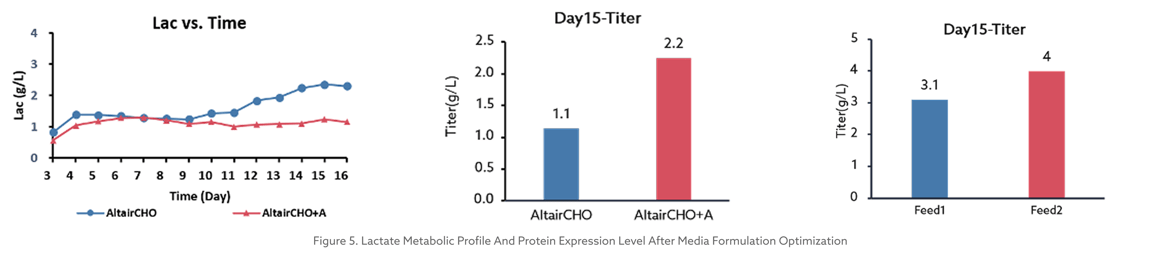
After switching to OPM's AltairCHO® media platform, lactate levels during cell culture were significantly reduced compared with the original process. Building on this improvement, OPM further optimized the basal and feed media formulations, effectively improving cellular lactate metabolism and ultimately increasing target protein expression by 260%.
OPM-CHO High-Efficiency Cell Culture and Protein Expression Solutions
To better meet the growing demand from biopharmaceutical companies worldwide for high-quality CHO cell culture media, OPM has developed a comprehensive portfolio of basal media, feed media, highly concentrated feeds, and supplements for various CHO cell lines, including CHO-K1, CHO-DG44, CHO-S, and CHOZN.
Through professional media design and Design of Experiments (DoE)-based optimization, OPM's chemically defined media are designed to support and maximize the growth of CHO cell lines and recombinant protein and antibody expression in high-density suspension cultures, delivering performance competitive with leading products in the global market.
Key Advantages
- Chemically defined formulation, with TSE/BSE documentation available
- GMP-compliant manufacturing
- Supports high-density suspension culture of CHO cells
- Widely used by leading pharmaceutical companies for the culture of CHO-K1, CHO-DG44, CHO-S, CHOZN, and other CHO cell lines
- Delivers an average 96% increase in protein expression
- Demonstrates robust lot-to-lot consistency, with RSD <5% for both intra-batch and inter-batch variation
- Available in both liquid (bottles or bags) and powder, with flexible packaging sizes
- Dual manufacturing sites ensure rapid and reliable supply
To learn more about OPM’s products or request free samples, please contact us.
References
- Pan, Xiao, et al. "Selection of chemically defined media for CHO cell fed-batch culture processes." Cytotechnology 69.1 (2017): 39–56.
- Marzluf, Jannis, et al. "Genetic drivers of Chinese hamster ovary cell proliferation revealed by functional genomics." iScience 28.11 (2025).